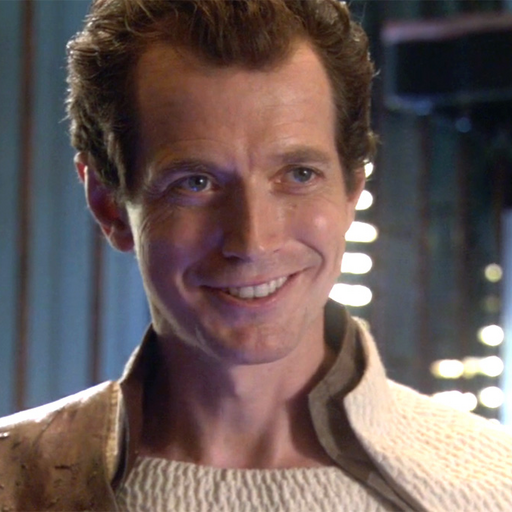
Everett Young carried everyone, and it wore him to pieces.
Rush got the speeches about purpose. Young got the ones about cost. That split is exactly right, because the show understood that the same mission looks completely different depending on where you're standing.
Young never wanted to be there. He said so. He was the wrong man in the wrong place with the wrong people, and he knew it before the first episode was over. What the show did with that admission over two seasons is one of the better things any Stargate series ever managed.
The early version of Young is competent and guarded. He delegates, he defers, he keeps himself at a professional distance. Then the distance starts costing him. His most raw moment comes in a radio call home, where the professionalism collapses entirely:
"Listen, I'm doing everything that I can. I'm going... I'm going to do everything that I can. I want nothing more than to get back here to be with you and I want nothing more than for you to be here for me when I do get off there. I'm just... I'm just saying I don't... I don't know when that will be. Please."
That stutter. The repeated "I'm going." The word "please" at the end of it. That's not a commanding officer. That's a man on the far side of the universe who doesn't know how to be a husband from there. The show didn't cut away from it or resolve it neatly. It just let it sit.
The crisis of command comes into full focus in "Justice," when Spencer is found dead and Young is a suspect. His response is the most quietly honorable thing he does in the run:
"Listen, I'm sure others will have alibis, but some of us won't. I can tell you for a fact that I was in my bunk sleeping at the time, but I can't prove that, and that makes me as much of a suspect as anyone. That is why I am turning over full control of the investigation."
He handed over his own command. Not because he was ordered to. Because he understood that a man who might be guilty of murder cannot investigate himself, and that the integrity of the process mattered more than holding the chair. Rush would never have done that. Young couldn't have done anything else.
But "Justice" also shows what it cost him. He knew the crew was fracturing. He knew that keeping command required letting the accusation stand long enough to destabilize his position. He walked into that deliberately:
"Well, there may not be enough to convict, but there's plenty to cast doubt. You know, if I force the issue, we risk dividing the crew. We can't afford that."
He stepped down. He handed Wray the ship. He did it because dividing the crew was the one thing he couldn't survive, even if he was innocent. That's the logic of command under impossible conditions: sometimes the right move is the one that breaks you personally so the mission holds together.
His confrontation with Telford in "Subversion" is where Young's moral weight becomes something else entirely. He's not performing authority there. He's using it as a scalpel:
"That's what's killing you, isn't it? Because this was supposed to be your prize, your reward for all that hard work: an entire year living with those criminals, thieves, murderers, pretending to be one of them. I mean, that's gotta take its toll."
"Remember that little combat engineer, Sanchez? Remember how she used to follow you around like a puppy? She was hit in the first blast. Right arm severed at the shoulder; she's screaming, yelling, begging me to help her. All I can do is watch her bleed to death in the dirt."
That second one is the one that matters. He wasn't recounting Sanchez's death to win an argument. He was showing Telford what betrayal actually looks like when it lands on specific people. The abstraction of "thirty-seven people killed" became one woman, one name, one moment Young clearly had not stopped seeing. He weaponized his own grief, and the weapon was real.
His reckoning with what he did to Rush on that planet is the other piece. He left a man to die. He knew it. And later:
"Well, if it means anything, I regret leaving you on that planet. Don't get me wrong: I think you deserved it, but I regret that I lost control, that I became a man that I couldn't respect any more."
That double-move is the whole of Young's character. He wasn't apologizing for the judgment. He was apologizing for the loss of the thing that made his judgment worth anything. The difference between those two regrets is enormous, and most shows would have collapsed them into one.
By "Gauntlet," after everything, he had this:
"Well, uh, we've been through a helluva lot together, that's for sure. I guess it would be easy to dwell on everything that we have lost, but I think today I would rather think about what we still have, and maybe what we've gained. We're, uh, we're a family now. Whether we like it or not. The sons, daughters, sisters... Even the, uh, slightly crazy uncle who despite everything, still manages to come through for you in the end."
"You are the smartest, bravest, most compassionate people that I have ever had the honor to serve with."
He didn't deliver that like a speech. He delivered it like a man who had used up most of his certainty and was saying the one thing he still knew for certain. Which is exactly right. That's what two seasons of cost looked like when it finally resolved into something.
Then he got into the stasis pod. And the last image of his command was him choosing to trust that Rush, the man he'd abandoned on a planet, the man who'd framed him for murder, would find the answer in time.
That trust was the whole argument. Not blind. Not easy. Earned, at enormous cost, by two men who were genuinely wrong about each other in ways that were also genuinely right.
SGU didn't do that with twists. It did it with speeches, with silences, with people who talked like they meant it. That's what this franchise earned and what the franchise can still earn again.